NBA Kelly Criterion Staking: Sizing Your UK Bets
 Available in US
I tried full Kelly for exactly one NBA season. By March I had a 38 percent drawdown on a strategy that the maths said had a long-run edge, and I was making bigger and bigger stakes on the bets I was most confident about. Eight years later I still flinch when I read a betting forum post that recommends full Kelly to a recreational bettor. The formula works in theory. The application in practice is brutal.
What changed for me was reading half-Kelly properly. Not as a “safer version” of full Kelly – that framing misses the point – but as the version of Kelly that survives the gap between your estimated edge and your real one. This piece is the working model I use now, and the reasoning behind it.
The Kelly Staking Formula Explained
Kelly tells you how much of your bankroll to stake on a bet, given the price you are getting and the probability you assign to winning. The formula is f = (bp – q) / b, where f is the fraction of your bankroll, b is the decimal odds minus one, p is your estimated probability of winning, and q is one minus p. Plug in numbers, get a stake size, place the bet.
The intuition behind the formula is simple. If your estimated probability is higher than the implied probability from the odds, you have edge, and Kelly tells you how to scale your stake to that edge. The bigger the edge, the bigger the stake. The smaller the edge, the smaller the stake. At zero edge, the formula returns zero – do not bet. That last property is why Kelly is mathematically elegant and why it appeals to anyone who has stared at a stake-size question for too long.
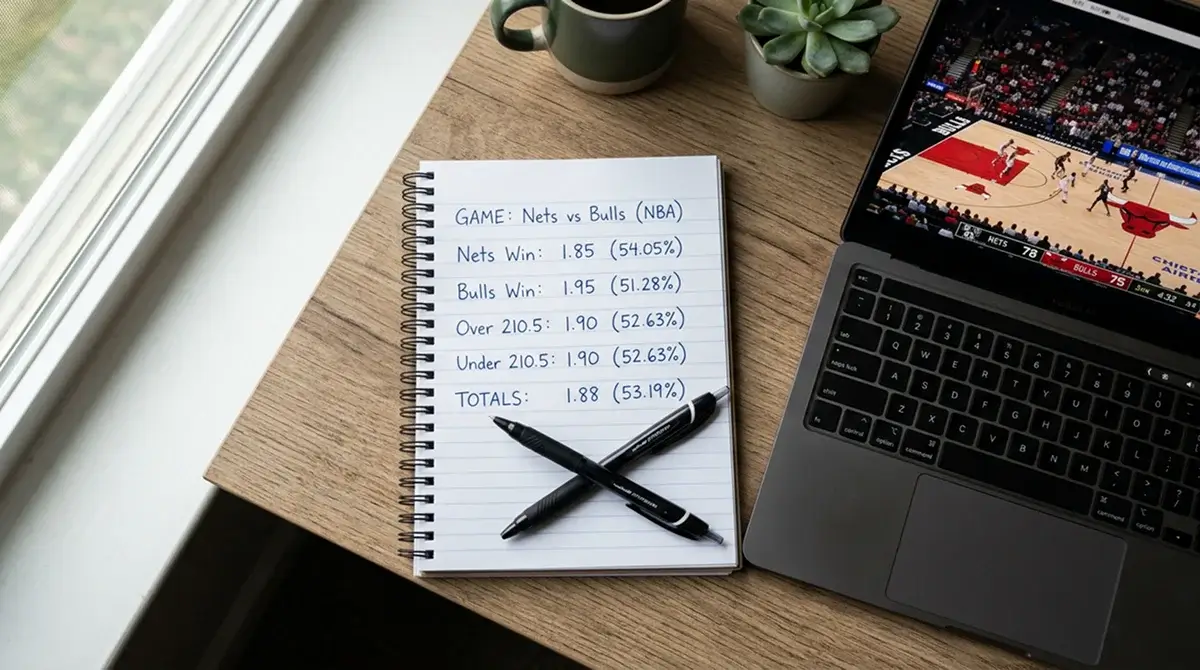
Worked example. Suppose you have an NBA total at decimal 1.95 and your model says the over has a 55 percent chance of landing. b = 0.95, p = 0.55, q = 0.45. f = (0.95 × 0.55 – 0.45) / 0.95 = (0.5225 – 0.45) / 0.95 = 0.0763. Full Kelly tells you to stake roughly 7.6 percent of your bankroll on that bet.
That stake size is large. On a £2,000 bankroll, full Kelly says £152 on a single NBA over. If you have ten such bets a week, you are putting roughly three-quarters of your bankroll in play at any given time. The formula says you should be comfortable with that. The formula is wrong, in a specific way I’ll explain shortly.
Applying Kelly to a Single NBA Pick
Where Kelly looks cleanest is on a single high-confidence bet, the kind of bet where you have a real probability estimate and a clear price. Most NBA bets do not look like that. Most NBA bets look like “I think this is probably the right side of the line”, which is not a probability estimate – that’s a feeling.
The discipline that makes Kelly usable is forcing yourself to assign a number. If you cannot say “I think this lands 56 percent of the time”, you cannot calculate a Kelly stake, and you should not bet the line at full size. The forcing function of producing a probability is itself the value of the formula – it makes you confront whether you actually believe what you think you believe.
The second issue is that NBA props sit on thin samples. A Kelly stake assumes your edge estimate is accurate. On a player rebound prop, your estimate is built on maybe 30 to 50 games of meaningful sample, against a bookmaker model that is built on team-level pace, opponent rebounding rate, usage projections and live injury data. Your edge estimate is noisier than the book’s. If you stake at full Kelly assuming a 5 percent edge, and your true edge is 1 percent, you are over-staking by a factor of five. The over-staking is what produces the drawdown.
That is the practical problem with full Kelly on NBA props. Not that the formula is wrong, but that the inputs you feed it are systematically over-confident. The bettor’s estimated edge is almost always higher than his true edge, because he has sampled less data, modelled less context, and discounted less of the bookmaker’s information advantage.
Half-, Quarter- and Eighth-Kelly
The fix is fractional Kelly. Stake at some fraction of what the full formula returns. Half-Kelly halves the stake. Quarter-Kelly quarters it. Eighth-Kelly cuts it to one-eighth. The headline benefit of fractional Kelly is reduced variance – the size of your drawdowns shrinks, often dramatically. The hidden benefit is robustness to edge mis-estimation – fractional Kelly tolerates being wrong about your edge in a way full Kelly does not.
The maths underneath is non-obvious. Half-Kelly captures roughly three-quarters of the long-run growth rate of full Kelly while halving the variance. That is a remarkable trade. You give up a quarter of your expected growth and receive half the volatility in return. For most bettors, particularly those whose edge estimates are noisier than they admit, that trade is the right one to take.
Quarter-Kelly captures roughly half the long-run growth rate of full Kelly while reducing variance further. Eighth-Kelly is essentially flat staking with a confidence-weighted nudge – the stake sizes barely move with edge.
Where I land for NBA betting personally is half-Kelly on bets where I have high confidence in my probability estimate and quarter-Kelly on bets where the estimate is built on thinner inputs. That two-tier approach concentrates stake size on the bets where my edge is most likely real, and protects bankroll on the bets where it might not be.
The Real Risk: Overestimating Your Edge
The reason fractional Kelly is the right default is that bettors systematically overestimate their edge. The OddsTrader AI model, which is one of the better-disclosed prop projection systems available, reports accuracy of 73.43 percent on its 5-star picks and 60 percent on 4-star picks, but only 45 to 48 percent accuracy on 2- and 3-star picks, and 17 percent on 1-star picks. Those numbers tell you something important: even a system with significant computational resources and disclosed methodology has wildly different accuracy across its own confidence tiers.
Most human bettors do not separate their picks into tiers, which means most human bettors over-stake their low-confidence bets and under-stake their high-confidence bets. Kelly forces the separation if you let it – bets where you cannot honestly assign a high probability deserve smaller stakes by formula.
The harder lesson is that even your high-confidence bets might be lower-confidence than you think. Variance over 30, 50, even 100 bets can mask a model that is not as sharp as you believe. The bettor who stakes at full Kelly on his “best 20 percent” bets and finds at the end of the season that his best 20 percent landed at 53 percent rather than the 60 percent he projected has lost real money on a structural mistake – not because he picked badly, but because he sized too aggressively given his actual edge.
Half-Kelly is the hedge against this. Quarter-Kelly is the harder hedge. The frame I work with is that fractional Kelly is not “the safe version” of Kelly – it is the version of Kelly that accepts that you do not know your edge as precisely as the formula assumes, and adjusts accordingly.
A Practical Stake-Sizing Table
For a working bettor, the formula needs to translate to a usable cheat sheet. Here is the version I keep on my desk for NBA bets, assuming a £2,000 bankroll and decimal odds in the 1.85 to 2.10 range, which is where most NBA spreads, totals and props live.
| Estimated edge | Full Kelly | Half-Kelly | Quarter-Kelly |
|---|---|---|---|
| 1% | £20 | £10 | £5 |
| 2% | £40 | £20 | £10 |
| 3% | £60 | £30 | £15 |
| 4% | £80 | £40 | £20 |
| 5% | £100 | £50 | £25 |
| 7% | £140 | £70 | £35 |
Read those columns and ask yourself: at half-Kelly, am I comfortable putting £70 on a bet where I think I have a 7 percent edge? If yes, fine. If no, you should be on quarter-Kelly. That comfort question is more useful than any further calibration of the formula, because it surfaces the gap between what the maths says you should stake and what you can psychologically tolerate when the bet loses.
The other discipline that the table forces is honest edge estimation. Most bettors who say they have a 5 percent edge actually have a 1 to 2 percent edge in the long run. Looking at the row that corresponds to your honest edge – not your aspirational edge – produces stake sizes that survive variance. That is what fractional Kelly is for. It is a tool for surviving the gap between estimation and reality, not a tool for maximising aggressive growth on assumptions that may not hold.
Once your stake-sizing is on a fractional Kelly footing, the next discipline is tracking whether your bets are actually showing edge in the long run, which requires logging closing line value across UK books. I have written about that in my CLV piece, and it pairs naturally with anyone serious about Kelly application.
FAQ
Does Kelly work for NBA player props with thin samples?
It works as a sizing framework, but the inputs are noisier than for established markets, which means quarter-Kelly is usually the right fraction rather than half. The thinner the sample behind your edge estimate, the more aggressively you should fractionalise. For a prop where you have 20 games of relevant data, eighth-Kelly is not unreasonable. For a prop where you have a full season of stable role data, quarter or half is defensible.
When should I deviate from my Kelly stake?
Two situations. First, when you suspect line movement reflects information you do not have – late steam on a number you backed early might mean your edge has evaporated, in which case stake smaller or pass. Second, when your bankroll has had a significant drawdown, scale stakes down to your reduced bankroll rather than your peak bankroll, because Kelly is a percentage of current bankroll, not historic high.
Written by the editors at bet of the day nba.