NBA Implied Probability: Calculating UK Decimal Odds
 Available in US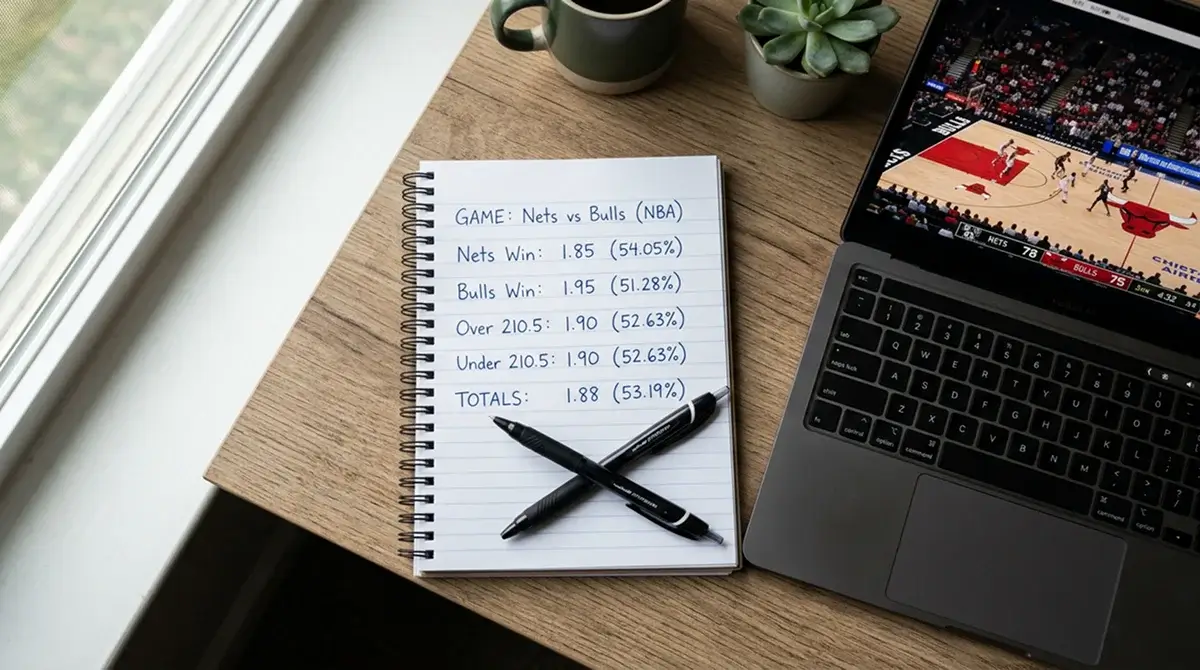
Ask a casual bettor what 1.91 decimal odds mean and you’ll get a vague answer about “almost evens”. Ask a professional and you’ll get 52.36 percent, before the vig comes off. The gap between those two answers is the gap between betting on instinct and betting on numbers, and it is the single most useful skill any UK punter can develop in their first month of NBA wagering.
This is the working version of how to read decimal odds as probability, why every UK book builds vig into both sides, and how to strip it out so you can see what the true price actually is. None of it is hard maths. All of it is unfamiliar until you do it five times.
Calculating Probability Conversions in Your Head
Decimal odds and implied probability are linked by a single formula: implied probability equals 1 divided by the decimal odds. That is the entire conversion. Decimal 2.00 implies a 50 percent probability. Decimal 1.50 implies 66.67 percent. Decimal 4.00 implies 25 percent. There is no second formula.
Once you have done the conversion ten or fifteen times, you do not need a calculator for the common ranges. Decimal 1.91 is roughly 52 percent. Decimal 1.83 is roughly 55 percent. Decimal 2.10 is roughly 48 percent. Decimal 1.50 is two-thirds. Decimal 3.00 is one-third. Build a small mental ladder of the values you see most often and the probability picture is in your head before the line refreshes.
What this gives you is the ability to read a market without translation. When a bookmaker lists a Lakers handicap at 1.85 and the over total at 1.95, you immediately see the implied probabilities at roughly 54 percent and 51 percent – and you can immediately compare those to your own probability estimate. If you think the Lakers cover 60 percent of the time at that handicap, the price represents value. If you think they cover 50 percent, it does not. The decision becomes mechanical.
The bettors who consistently struggle with stake sizing and bet selection are usually the bettors who never learned to read the price as probability. They are betting “the Lakers” or “the over” rather than betting “54 percent represented at 51 percent” or “60 percent represented at 53 percent”. The probability framing is what makes line value visible. Without it, every bet feels equally good or equally bad based on whether the team or the player feels right that night.
What the Vig Is, and How It Hides
The vig – short for vigorish, sometimes called the juice or the overround – is the bookmaker’s built-in margin. It is what makes a 50-50 market not actually price both sides at decimal 2.00. When you see a moneyline market with one side at 1.91 and the other at 1.91, both implied probabilities sum to 104.7 percent rather than 100. That extra 4.7 percent is the vig. It is the bookmaker’s expected profit on a balanced book, and it is the reason that beating the bookmaker requires not just being right more than half the time, but being right enough to overcome the vig as well.
The vig hides because the implied probabilities of a two-way market never look obviously inflated. If you saw a 60-60 split, your alarm would go off. The 52-52 or 53-53 split feels normal, and the extra few percent of margin disappears into the texture of the line. The discipline of converting both sides to probability and adding them together is what makes the vig visible – and once it is visible, you can think about pricing properly.
Vig levels vary by market and by book. Standard moneyline and main spread markets on UK books typically run 4 to 5 percent vig. Player prop markets often run 6 to 9 percent vig, occasionally more on niche combinations. In-play markets typically run wider still – sometimes 8 to 12 percent – because the live pricing model has to compensate for both volatility and the speed at which the price is being offered.
The Gambling Commission’s industry data showed online sector GGY hitting £7.8 billion in the financial year ending March 2025, with remote betting GGY at £2.4 billion of that – those numbers are downstream of the cumulative vig collected across the season. The vig is not the bookmaker’s whim; it is the visible component of the operator’s revenue model, and understanding it is understanding what game you are playing when you place a bet.
Removing Vig From Two-Way Markets
The technique for finding the “fair” price implied by a market is to strip out the vig proportionally. For a two-way market, the procedure is straightforward. Take the implied probabilities of both sides. Add them together to get the total overround. Divide each side’s implied probability by that total. The result is the no-vig probability for each side, which sums cleanly to 100 percent.
Worked example. A handicap market is priced at 1.91 for the favourite and 1.95 for the dog. Implied probabilities are 1/1.91 = 52.36 percent and 1/1.95 = 51.28 percent. Sum is 103.64 percent. Favourite no-vig probability is 52.36 / 103.64 = 50.52 percent. Dog no-vig probability is 51.28 / 103.64 = 49.48 percent. The book’s true assessment, stripped of margin, is that the favourite covers about 50.5 percent of the time.
That number is what you compare against your own probability estimate. If you think the favourite covers 53 percent of the time, the no-vig fair price would be decimal 1.89, and you would need to find a book offering 1.89 or better to be at break-even on EV – anything longer than 1.89 is a positive expected value bet. The visible price of 1.91 is sitting just above your fair value threshold, which means it is a marginal +EV bet rather than an obvious one.
The discipline this builds is the habit of always asking, “What is the no-vig fair price?” rather than “Is this price good?” The first question is answerable. The second is not. Two-way markets are the easy case, and they are also the case where you do most of your NBA betting – moneyline, handicap, totals, two-way prop overs and unders. Master the no-vig calculation here and you have built the most important pricing habit a bettor can develop.
Three-Way and Multi-Way Markets
Three-way markets exist on the NBA but are less common than in football. The classic example is correct quarter or half winner with a tie option, or specific scoring brackets within a margin market. The principle for stripping vig out of these markets is identical to the two-way case: sum the implied probabilities, divide each by the total, the result is the no-vig probability per outcome.
The complication with three-way markets is that the vig is often applied unevenly across the outcomes. A bookmaker pricing a three-bracket margin market might apply heavier vig to the most popular bracket and lighter vig to the less-fancied ones. The blunt no-vig adjustment does not capture this asymmetry – it gives you a uniform stripping that is reasonable on average but not always representative of the book’s specific assessment of each outcome.
For multi-way markets – first basket scorer, exact margin within a 10-point band, exact final score – the vig is typically very heavy and the no-vig calculation gives you a useful but rough fair price. These markets are not where I do my regular betting and are not where I would recommend a UK punter focuses serious analysis. The vig structure makes consistent edge difficult, and the alternative markets – main spreads, totals, props – offer better risk-reward at lower vig levels.
The exception is exotic markets that occasionally surface as price-boost specials on UK books. A first-quarter winner price boost might temporarily lift one outcome to a level where, even with the heavy underlying vig, the boosted price is no-vig favourable. Spotting these requires the discipline of doing the no-vig calculation on the boosted price specifically, not just trusting that the boost makes it a good bet by definition.
Using Fair Odds to Spot Mispriced Lines
Once you have the no-vig fair price, the comparison with your own model becomes the bet selection process. The bettor who consistently identifies markets where his probability estimate is materially different from the no-vig fair price is the bettor who has edge. The bettor whose probability estimates roughly match the no-vig fair prices is essentially a coin-flipper paying vig.
The harder honesty here is calibrating your own probabilities. The OddsTrader AI model that publishes its accuracy by confidence tier – 73.43 percent on 5-star picks, dropping to 17 percent on 1-star picks – illustrates how much variation exists in probability estimation even among systematic methods. Your own estimation is unlikely to be more accurate than a published model, which means your bets at the margin of value are bets where your probability advantage is small and your vig disadvantage is real.
The discipline that turns the no-vig calculation from a calculator exercise into a bet-making framework is selectivity. Do not bet markets where your probability estimate is one or two cents off the no-vig fair price – that is not edge, that is noise in your own estimation. Bet markets where the gap is meaningful – five cents or more – and even then, size the bet relative to how confident you are in your estimate. The fair-odds framework does not eliminate the need for judgement; it just gives the judgement a structure to operate inside.
For a UK punter learning to read prices this way for the first time, the practical recommendation is to spend a week converting prices to probability without placing any bets. Read a slate, calculate the no-vig fair prices, compare with your gut feel, see where your gut and the maths agree and where they disagree. After a week the conversion is automatic, and the bets you place from that point onward are framed in probability rather than in price. That reframing alone is worth more than most strategy advice. The natural next step from this foundation is converting it into a moneyline-specific approach, which I have written about in my UK moneyline piece.
FAQ
Is no-vig pricing always the ‘true’ probability?
It is the bookmaker’s best estimate, stripped of margin, and over time it is closer to the true probability than any individual bettor’s estimate is likely to be. But it is not perfect – markets can have biases, particularly on popular teams or popular props, where vig is sometimes applied asymmetrically. Treat the no-vig fair price as a strong reference, not a gospel.
How does the vig differ on NBA props vs moneyline?
Moneyline and main handicap markets typically run 4 to 5 percent vig on UK books. Player prop markets routinely run 6 to 9 percent, with combination props and niche stats running higher. Live in-play markets often run 8 to 12 percent. The wider the vig, the more accurate your probability estimate needs to be to overcome it.
Created by the ”bet of the day nba” editorial team.